Saturday, September 20, 2008

Strangely Built Shacks


I know it's kind of a cop-out to just glom on to someone else's work, but Jack Neely has a compelling article this week in the Metro Pulse about the "shanty towns" of houseboats and boathouses that were prevalent along the Knoxville waterfront for many decades up into the 1960's. I've always been fascinated by this subject, as the husband of a friend I once worked with actually grew up among this population of folks.
Anyone who has ever read Cormac McCarthy's "Suttree" has probably found themselves trying to imagine this odd community of people living on the fringes of Knoxille society. Now, thanks to Jack's excellent work and archived data from a project commissioned by the Tennessee Vally Authority long ago, we can finally know just what this area of town looked like.

Thanks Jack!

Wednesday, September 10, 2008

John H. Simpson


The portrait on the left is of General Nathan Bedford Forrest, a confederate cavalry commander whose military genius was so formidable that Rommel studied and applied his methods to desert tank warfare during WWII.
When I was younger, I admired Forrest for his prowess and his prolific military strategies. Of course, that was before I became aware he is generally regarded as the founder of the Ku Klux Klan.

It was also before I learned that my own 2nd great-grandfather, John Harrison Simpson (the second photo) was captured by Forrest's raiders at a place called Sulphur Branch Trestle and subsequently remanded to Cahaba, one of the South's most notorious military prisons. This is his story-

John H. Simpson was born May 24, 1848 and died July 1, 1929 in Knox County, TN. On September 14, 1863, John enlisted in the Union Army at the age of fifteen. His daughter, Jessie Bloom, told me that he lied about his age in order to be allowed to muster in. He was assigned to Company I, 3rd Regiment of the Tennessee Cavalry. Two weeks later, John’s father, Green Simpson, also enlisted and was assigned to the same company and regiment. I suppose no one will ever know if Green’s enlistment resulted from inspiration at John’s courageous act of patriotism, or if he simply joined to be able to keep a watchful eye on his obviously headstrong son.

The following paragraph, which describes the events immediately preceding John Simpson's capture, is paraphrased from the book “The Sultana Tragedy” by Jerry O. Potter:

In September of 1864, as Sherman took Atlanta and prepared for his infamous “March to the Sea”, the Union 3rd Tennessee Cavalry was assigned to help safeguard a system of railroad lines at Sherman’s flank in Northern Alabama. These railroads were essential to the flow of supplies to the invading Union Army, and the two main fortifications guarding the lines were at Athens and Sulphur Branch trestle. John’s company was one of several that were ordered to guard Sulphur Branch trestle, which was defended by two formidable blockhouses manned with nearly 1,100 men. Confederate Lt. General Richard Taylor, commander of the departments of Alabama, Mississippi and East Louisiana, dispatched a regiment of confederate cavalrymen to destroy these supply lines in an effort to slow Sherman’s forces. The confederate cavalry arrived in the area on the evening of September 23rd. Unfortunately for the Union soldiers involved, the commander of the confederate cavalry was General Nathan Bedford Forrest.

Forrest moved first on the Union position at Athens, and quickly forced the surrender of nearly 600 union soldiers. This was done almost completely without bloodshed, as Forrest paraded his troops past the heavily fortified garrison, having them mount and dismount so as to give the appearance of having more men at his disposal than he actually did. The commander of the fort at Athens concluded that Forrest commanded a force of nearly 10,000 men, when the number was actually less than half that figure. Following the surrender of the troops at Athens, (as well as 700 more soldiers who were attempting to relieve the garrison), Forrest turned his attention on the Sulphur Branch trestle.

My great Uncle, John Alexander Moore, gives the following account of the capture of John H. Simpson (his grandfather) at Sulphur Branch trestle:

“John H. Simpson’s company was captured by confederate cavalry under Nathan B. Forrest while bivouacked around Chattanooga. My grandfather often spoke of the tense moments spent waiting for the confederate attack, and then suddenly hearing the awful “rebel yell” and seeing the confederate troops come charging in on their position with their sabers slashing. Before he had time to react, he was overrun by one of the charging horsemen. The horse stepped down and smashed his thigh and side. He was soon after captured and removed to the Cahaba prison for Union soldiers. When I was a boy, my grandfather still bore the terrible scars on his side and leg from this occasion.”

In all, Forrest captured around 2,300 union soldiers on September 24 and 25. While the officers from the captured garrisons were quickly paroled, the enlisted men were sent to the confederate prison camp at Cahaba, on the banks of the Alabama River near Selma. This camp, while not as widely recognized as its notorious counterpart, Andersonville, was nonetheless maintained under conditions so deplorable that its inmates soon died as surely as if they had been hit by cannon or bullet. Each man within the prison had an estimated six square feet of living space, and typhoid, scurvy, dysentery and malaria ran rampant throughout the camp.

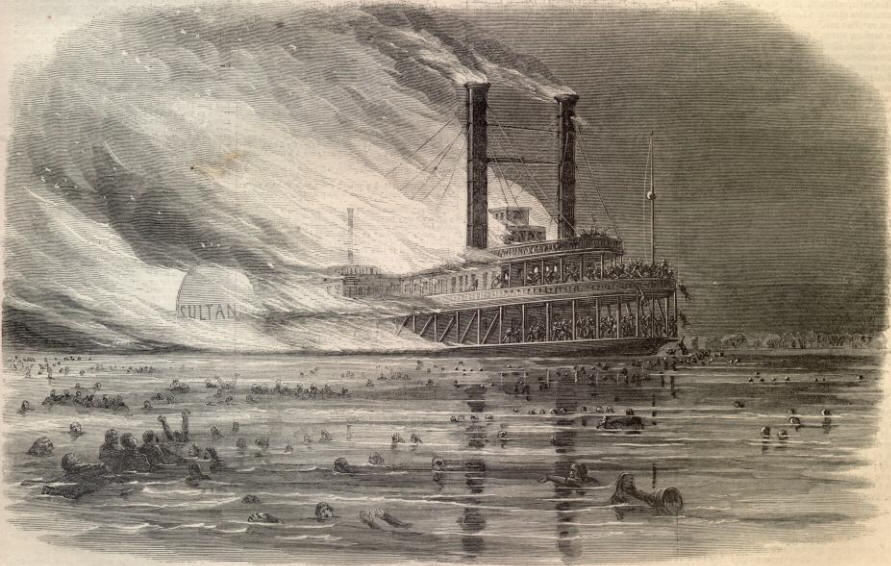
John managed to survive the horrible conditions at the camp, and on March 20, 1865, he and other soldiers from the prison were assembled as part of an exchange initiative to be executed between several northern and southern prison camps. The soldiers were transported to Camp Fisk, near Vicksburg, Mississippi to await transportation north to Camp Chase, Ohio and Jefferson Barracks, Missouri. On the night of April 24, 1865, the men were loaded onto the steamer Sultana, one of several large steam ships contracted by the U.S. government for the transport of northbound union soldiers. The Sultana’s legal carrying capacity was 376, but by the time the steamer left Memphis, Tennessee on April 27th, there were over 2400 people on board, the vast majority of whom were union soldiers. The owners of the boat saw this as nothing more than a lucrative business venture, and the men were subsequently packed like sardines onto the outer decks. At 2:00 AM on the night of the 27th, the Sultana’s recently repaired boilers, under duress from the sheer number of passengers on board, exploded in a firestorm that sent men by the hundreds hurtling through the air and into the frigid waters of the Mississippi. Many of those that had not been killed outright by the blast were soon consumed by the cold, dark waters of the river. Some who were fortunate enough to find buoyant debris in the water were either able to make the shore or were soon rescued by the throngs of civilian boats that arrived shortly after the blast was heard. John managed to paddle to the shoreline, where he was eventually located and transported back to Memphis for treatment of his wounds. He was fortunate. His cousin, Joseph Simpson, was not.

Of the nearly 2400 men on the boat that evening, 1800 perished in the river, making the Sultana the single worst maritime disaster in U.S. history. How bitterly ironic that these men who had bravely endured battle, capture and deprivation in the prison camps, would
meet such a senseless end.

John would eventually end up in Nashville, where he mustered out of the army on June 10, 1865. His father, Green Simpson, had made it on to Camp Chase, Ohio, and mustered out a short time later.

John soon came home to Knoxville, and on October 24, 1869, he married Margaret Issabella Flenniken in Knox County. Margaret was a member of the prominent Flenniken family that resided along Maryville Pike near the Mt. Olive section of South Knoxville. John and Margaret reportedly inherited land from the Flennikens, and established a farm near the old Maryville Turnpike. John and Margaret sold several acres of land over the next few years, and in March of 1892, John bought a right of way for a road and five acres of land on Maryville Pike in the 13th district. Lois Haddox Bell, a granddaughter of John H. Simpson, told me that the old Simpson farm was located on the left of Maryville Pike (going toward town), where present day Woodson Road turns off. She said that the Simpson house was up on a hill set back off the road and that it burned long ago. Several houses are reportedly located on the site now. John and Margaret clearly became members of Mt. Olive Baptist Church at some point, but the records of Mt. Olive Church currently on microfilm at the McClung collection do not give a clear indication of exactly what year they transferred. The record indicates that John and Margaret joined by letter on February 7, but the year is illegible. The burial of at least two infant children of John and Margaret at the Island Home Baptist Cemetery indicates that the family may have been members at that church prior to their transfer to Mt. Olive.

In 1880, John H. Simpson and a group of his East Tennessee comrades from the Sultana formed the Sultana Survivors’ Association. The group met on April 27th of every year for over fifty years, to commemorate the tragedy and to celebrate the fortune and courage that were required to survive such an ordeal. As the United States Congress refused to appropriate funds for the commission of a memorial to the Sultana tragedy, John Simpson became instrumental in commissioning and dedicating a beautiful stone memorial in Mt. Olive Cemetery, beside the church where the reunions were often held. The ranks of the survivors diminished year by year. John was the second to the last survivor when he passed away in 1929.

John H. Simpson died on July 1, 1929. His wife, Margaret, died fourteen days later. Both are buried at the Mt. Olive Baptist Cemetery in South Knoxville, just a short distance down Maryville Pike from where they had made their home. I have in my possession several photographs of John and Margaret Simpson, and it’s evident by John’s countenance in each photo that he had a genuine passion for life. From the brash teenager who lied about his age in order to enlist in the Union Army to the tenacious old man who would not let his country forget the tragic events surrounding the Sultana’s ill-fated journey, John H. Simpson lived his life to the fullest, and in all likelihood looked upon death as nothing more than the next great adventure.

Saturday, August 23, 2008

The Little Tennessee, Revisited

Tonight I drove down to the Morganton Cemetery in Loudon County. The cemetery, bearing the remains of three sets of great grandparents, is the only tangible remnant that's left of a once-thriving river port on the banks of the Little Tennessee River. Today, the town of Morganton, along with the capitol towns of the Overhill Cherokee nation, hundreds of family farms and what was arguably one of the finest free-flowing trout streams in the Eastern United States, has been completely inundated by the Tellico Lake Reservoir.

The town of Morganton was situated at the mouth of Baker's Creek on the east bank of the river. During its heydey, it was a bustling port that supplied flatboat traffic trading up and down the Tennessee River basin and beyond. My family moved into the area in the 1840's.
At the turn of the century, my great-grandfather, John Allen Anderson, was the town doctor; my second great grandfather, Reverend David M. Kerr, was a prominent local minister.

When I was young, my grandfather, Oren Kerr Anderson, used to entertain me with tales of his adventures growing up in Morganton, fishing and playing along the banks of the river. He said the sturgeon in the river were legendary, and that it was not infrequent for flatboat fishermen to land specimens weighing well over 100 pounds. He told me the men would hook the fish initially and then rig the lines to teams of mules on the boats to haul them in.
He remembered there was a spring that flowed from under the cemetery hill in town, and that the "colored folks" all refused to drink from it. My great-grandfather owned the first automobile in Morganton, and I have a photograph of my granddad sitting behind the wheel, surrounded by local girls and holding a cigar, looking all of maybe 15.

Like my grandfather before me, many of my fondest memories of childhood are also associated with that river. It was there that I learned to fly fish, often wading into the wild, dark waters before dawn with my father; warming myself in the early morning sun as the first hatch came off and the trout began to rise. There I learned the 10-2 method of the cast; how to mend my line upstream and ultimately how to effect a convincing drift with a caddis fly nymph. Some days we would catch 30 or 40 good-sized fish before 10 am; always with a wary eye upstream toward the imminent possibility that the waters would rise suddenly when the turbines in Chilhowee Dam began generating.
It was also here, along the banks of this river, that I found several beautiful arrowheads, and my father would relate to me the long and ultimately tragic history of the Overhill Cherokee; their ancient capitol of Chota located just adjacent to where we fished.
And yes, the sturgeon were still there, sometimes visible as huge and ominous looking shadows sweeping across the river bottom just ahead of our approach.

The impoundment of Tellico Lake is one of the most egregious examples of greed and political impropriety in recent East Tennessee history. Others more eloquent than myself have aptly chronicled the tragic destruction of the Little Tennessee River, and the story bears remembering.
I was 13 when the fight to save the river was finally defeated through underhanded political maneuvering by a couple of local politicians, and its loss was as deeply affecting to me as the death of a close relative.
Our family had roots there, and now nothing remains but endless lakefront developments, the cemetery and the still, deep waters of the lake.


Wednesday, August 20, 2008

"Martyred"


John S. Crye was the brother of my 4th great grandmother, Mahala Crye Anderson, and lived in the Alleghany Springs/Lanier section of Blount County in the mid-1800's. When I located and photographed his grave at Williamson's Chapel UMC several years ago, I noticed the headstone had the word "Martyred" inscribed adjacent to the date of death. I later did a little research and uncovered this information from the writings of the late Ed Best, one of Blount County's most noted archivists and historians. His 2nd great grandfather, George Best, was also involved in the proceedings that ultimately lead to the violent death of both men.

(From the notes of Edwin J. Best)

John Simeon Crye, familiarly called “Shimmon”, was the youngest of the three sons of John and Martha Jones Crye. He was born in Blount County on August 16, 1828. On September 30, 1857, he married Sarah Best, a daughter of George and Jane Roach Best. These neighboring families lived on the mountainous side of the county, in the watershed of Nine-Mile Creek and not far from Allegheny Springs.

John S. Crye was a farmer and fairly well-to-do for the time. In 1860, he estimated his real property to be worth $1, 800. He valued his personal property at $888. The Cryes had three children: George H. (born Sept. 28, 1858), Martha (born about 1862) and John Riley (July 13, 1863).

When the Civil War broke out, John S. Crye, then 33, chose to remain at home to tend his farm and look after his growing family. He was the last of the Crye sons. His brothers Elihu and Elias and his father and mother had all died between 1857 and 1960. The Cryes and the Bests were strong Unionists in a divided county. Three of his Best brothers-in-law saw service in the Union Army. John S. Crye was a member of the Home Guard of the Seventh District of Blount County, although he did not live in that district.

The Home Guard was an unofficial organization whose members tried to protect the property of private citizens from the depredations of roving guerrilla bands that plagued Blount County for the duration of the war. Membership in the Home Guard and display of pronounced Union sympathies often drew the attention of Pro-South bushwhackers. When these armed desperadoes were in the area, the prudent among the Unionists did their best to hide their goods and animals and took to the woods and mountains, there to hide until the danger was past.

Union soldiers made their first appearance in Blount County on Sept. 2, 1863, and for a few weeks, the loyalist citizens felt secure. On Nov. 13 General Wheeler came into the county with three brigades of Confederate cavalry and on the following day, drove out the occupying U.S. forces.

On the same day that the brief Federal hold on Blount County was broken, a band of Confederate bushwhackers appeared along Nine-Mile Creek looking for Unionist sympathizers. Many loyalists went into hiding, but not all escaped. The Bushwhackers captured two members of the Home Guard, Larkin Anderson and Lawson Fields. They next went to the home of John S. Crye, another member of the guard, who was in hiding with his father-in-law, George Best. One of the bushwhackers went to the Crye house where he found Josephine Crye, a younger sister of John S. Unmarried, she had lived with her brother since the death of their parents in 1859. The guerrilla identified himself as a friend and companion of Crye, and persuaded the innocent Josephine that her brother’s life was in grave danger. He must, he said, find him and escort him to some safer place before the bushwhackers could take him. Josephine disclosed her brother’s hiding place, and in short time, he and George Best were in the hands of the desperate outlaw band.

The three home guard members were murdered near George Best’s mill on Nine-Mile Creek. They were given permission by their captors to drink from a spring. When they were lying on their stomachs lapping up water, they were killed, each shot through the back.

George Best had three sons in the Union Army. He, too, was marked for execution. For some reason he was spared for a while. The guerrilla band took him to the Little Tennessee River and at Henry Ferry, just over the county line in Monroe County, they shot him and left his lifeless body where it fell.

John Crye was taken to Williamson Chapel Cemetery where his father, mother and two brothers had so lately been laid to rest. His children, or someone acting for them, erected a small monument to his memory. At the top of the stone is a medallion, in which is carved a single flower drooping on a broken stem. The tombstone reads:

Untimely Grave of our Dear
Father
John S. Crye
Martyred Nov. 13, 1863
aged 35 yrs. 2 mos. 27 ds.
Died for His Country’s Sake

The newly widowed Sarah Crye and her three little children were soon the victims of another cruel fortune of war. Union troops moving through Blount County in late 1863 requisitioned her grain and hay. They took 124 bushels of corn, 67 ½ bushels of wheat and almost a ton and a half of hay. A long, hard winter lay ahead, and while the government reimbursed the estate of John S. Crye in the spring of 1864, the deferred payment could not feed the family and farm animals between the death of the father and the coming of the next crop.

The perpetrators of the Nine-Mile Creek massacre were never brought to justice. A guerrilla band suspected of bushwhacking was captured at Chilhowee on the Little Tennessee River on January 12, 1864. But its members were subsequently released by military commission in Knoxville when charges against them could not be substantiated.

When the war was finally over, Sarah Crye was visited by one last tragic event. In 1867, her mother fell down the steps in front of her house with a pipe in her mouth, and sustained a fatal throat injury.

On March 19, 1868, Sarah married William A. Armstrong. They had one child, Dolly Ann, born in 1869. Sarah Armstrong died on February 14, 1899.

Thursday, August 7, 2008

Simpson's Ferry


Update- Recently (February 09) received the lower picture over e-mail from a cousin. It's a sketch of the area around Simpson's Ferry and not only indicates the site of the ferry, but also the Jesse Simpson (Jr.) house. Thanks Susan!

The following is an excerpt from the writings of Katherine Baker Johnson, regarding the life of her grandfather Jesse Simpson, Jr. (Jesse was the brother of my fourth great grandfather, Sanford Simpson). These notes were written c. 1940-

In 1869 Jesse Simpson Jr. bought from John Jones 116 acres of land lying along the south bank of the Tennessee River about 1 mile east of the Knox County Courthouse. After the Knox County toll bridge was blown down in a small cyclone about 1875, Jesse Jr. established a toll ferry near his home. Jackie (John) Jones also owned a ferry which crossed the river near where the present Gay Street Bridge crosses over. For the accommodation of his customers Jesse Jr. built a large shed near his ferry. This shed had sleeping quarters at one end and a large fireplace for cooking. Usually there was a supply of free wood for fires during cold weather. The writer has seen as many as a dozen mountain wagons and their owners camping there at one time. The huge wagons with their billowy white covers and loaded with apples, chestnuts and other products of the mountain farms, were drawn by oxen. Roads were poor in those days and oxen were sure-footed and well adapted to mountain travel. Sometimes, after spending a night at the convenient Simpson Camp, enjoying its shelter and often the free firewood, the mountaineer would turn his oxen and drive off to cross the river on his competitor's ferry closer to town. This was most exasperating.

Although the exact the location of Jesse Simpson's ferry has been lost to history, one can assume from the descriptions above, as well as the current location of "Simpson Avenue" (a short stretch of road situated about halfway between Island Home and the Gay Street Bridge) that the location of the ferry was somewhere in that general area. The photo and map above probably reflect the original location of the property and ferry. Jesse Simpson's holdings in the area also included the quarry along Island Home Pike, as well as the adjacent property containing the Cunningham-Flenniken Cemetery.

Friday, July 25, 2008

Preußen


Attached is the passenger manifest for the German ship Adolph, which arrived at New York Harbor from Hamburg, Germany on October 9, 1848. The first image shows the title page to the manifest; the second is taken from the passenger list itself. The ship bore several hundred passengers when it arrived that day, many of whom were immigrants from Germany and its provinces bound for a new life in America. One such immigrant, John Zastrow, arrived with his wife and five children from Pommern, Prussia. John Zastrow was my second great grandfather, and his name, along with those of his family, can be seen just down the page a bit in the second image. (Family tradition has always maintained that a sixth child died on the passage and was buried at sea- something that seems corraborated by the brief notation after Carl's name.)

Not much is known about John Zastrow's early life, or why his family ultimately migrated to the United States. Information passed down throught the family tells us he was born in Pommern (Pomerania), a fact later born out in census data and in the Ellis Island Foundation's archives. I've heard a number of conflicting stories in recent years regarding his reason for coming to America- some of which were plausible, some not so much. I've done some research on the subject and, having no written family record on the matter, can only offer the following data and speculation-

There was a fairly consistent migration of people from the German provinces to the United States throughout the 19th century. However, there were substantial peaks in the migration patterns at several intervals across that continuum. One such peak originated in the late 1840's and carried on through much of the 1850's. Immigration itself is usually predicated on two types of motivators- "push" motivators (famine, religious persecution, privation) and "pull" motivators (religious freedom, the promise of wealth and/or land ownership, etc.) During the period in which the Zastrows arrived in the U.S. (and for several years thereafter) there was a "perfect storm" of push/pull factors impacting immigration from Germany.

Push Motivators-In the 1840's, "Germany" was essentially a loose confederation of 38 states, nearly all of which were presided over by individual monarchies. On the heels of (and undoubtedly inspired by) the revolution in France, liberal protests swept through all of Germany in a wave of demonstrations and calls for unification of the government and representation of German citizens through parliament. By 1847 the individual protests had matured into an organized revolution operating throughout Germany, and actually resulted in abdication by several of the monarchs involved.
During this time, significant population growth coupled with the failures of harvests in 1846 and 1847 led to widespread famine. Additionally, in 1847, a cholera epidemic swept through Prussia, leading to much death and suffering. The revolution ultimately failed in 1848, but not before reducing much of Germany to a state of economic and political chaos. In Prussia, nearly 6,000 supporters of the revolution fled ahead of persecution by the re-established "old guard". This wave of political refugees was so significant, the immigrants became known collectively as the "Forty-Eighters". As this was the year the Zastrows arrived in the U.S. from Pommern, there may be at least some truth to the assertions I've heard that John and his family left Prussia due to his political associations. It is certain that Prussia in 1848 did not seem to be a very pleasant place to live.

Pull Motivators- Major crop failures similar to those of 1846-47 had previously swept through much of Germany in 1816, prompting a first wave of 20,000 immigrants to the U.S. throughout the teens and into the 20's. These immigrants traditionally settled in clusters in specific locations, most often associated by their regions of origin. This first wave of immigrants maintained contact with friends and family in their native lands, and often conveyed potent images of religious and political freedom and of opportunities for private land ownership to the folks back home. This image of life in America would have proven particularly compelling to those left sick and/or destitute by the massive crop failures and political unrest in 1848 Prussia.

Whatever the impetus for John to uproot his family from their native lands, make the trek to Hamburg and board a ship bound for the U.S.; we do know that he arrived here in 1848 and ultimately settled in Wisconsin along with countless other immigrants from Pommern and the surrounding region. There, the census records tell us, he remained for the rest of his life; his place of birth alternately listed in official records as Germany, Pomerania and Preußen, the German spelling of Prussia. Whatever station he'd held, and whatever travails he and his family might have experienced during his former life in Pommern, John passed his remaining days as a simple farmer, raising his family and working his own land; realizing the common American dream.

Thursday, July 17, 2008

"It's not the mountain we conquer, but ourselves." - Sir Edmund Hillary

I know this is a blog dedicated to history, but I had to give some props to my nephew, Phillip, for completing his first Century in Southwest VA on May 25. The race was called Mountains of Misery, and, having driven over a great deal of the topography covered by the route, I was convinced it was pretty aptly named. He finished within seconds of his goal time.

Congratulations man! (and sorry for glomming your pic off Picasa)

(And here's the obligatory historical reference- the race actually finished at the historic Mountain Lake Hotel where "Dirty Dancing" was filmed on location. It's gorgeous.)

Thursday, May 15, 2008

Faith of Our Mothers


Charlotte, Martha and Julia Zastrow (l-r)
1903


In November, 2006 I was preparing my portion of a eulogy for my father's memorial service. My father, a Methodist minister for nearly forty years, had been the person I admired most in the world and so I worked doubly hard in the days preceding the service to ensure that I had adequately captured what I felt was the essence of a life amazingly well lived. My eulogy included poignant memories, funny stories, a synopsis of my father's outlook on life; all the makings of what I believed to be an eloquent farewell to my dad.

A day or two before the service, my brother, sisters and I were at my father's house half-heartedly dividing up those family items that we would each keep. As we did so, I found myself holding an old tattered bible that had actually belonged to my great-grandmother. As I sat pondering the bible, I became aware that I was in essence holding a tangible manifestation of the very genesis of my parents' faith and ultimately, my father's ministry. I knew then that the message I'd written for my dad's service was all wrong.

Martha Leona Fielding, my great grandmother, was born in Alabama in 1875. She married Julius Hermann Zastrow, a German immigrant almost 30 years her senior and the owner of the massive depot and commissary at Guntersville landing. Julius died within just a few years of their marriage, but not before Martha had borne two daughters; Charlotte and my grandmother, Julia. Martha subsequently remarried and eventually move to Somerville, Tennessee. Following the death of her second husband, she moved in with her eldest daughter, Charlotte (Tua) and her family in Memphis. There she lived for the rest of her life, helping to raise Tua's children, as well as my mother and aunt Wini after Julia passed away suddenly at age 33.

My great grandmother was a devout Christian, as were my grandmother and my mother. My mother's own first experiences with Christ came as her grandmother would read to her and interpret the stories from her bible. From these first special moments spent with her grandmother, my mother's own spirituality would grow and develop into a tremendous faith that remained with her the entirety of her life. That faith would inspire my father, who was raised outside of the church, to become a Christian, and later, a minister. His own ministry would in turn inspire countless others in their own journeys of faith, and many of his parishioners would themselves eventually enter the ministry to tend congregations of their own.

The day I found my great grandmother's bible, I rewrote my father's eulogy completely. I chose not to dwell on anecdotes or even insight from his life, but rather on those tiny seeds of faith passed on to my mother from her grandmother all those years ago- seeds that would ultimately be passed on to my father and blossom into an incredible 39 year ministry. A true legacy, passed down across the generations through the strong women of our family.

Friday, May 9, 2008

Namesake

Not everyone has a namesake- that is to say, being named for an actual person. I happen to have one- though until today, I'd never seen an actual photo of the man. His name is Mark Cathey, and his are some big shoes to fill.

When my parents were young, one of their routines involved my mother reading to my father in bed each evening to help him wind down from the day. My mother had a style and a voice well designed for narration, and enjoyed reading immensely. She would seek out stories that would interest my father, and each night she read from a wide range of literary sources- from Reader's Digest condensed stories to magazine articles to full length books. One such book was an underground classic by a gentleman named Jim Gasque.

Jim Gasque, as far as I can tell, wrote only two books in his life. One was a full-length treatise on bass fishing; the other was the truly transcendent "Hunting and Fishing in the Great Smokies". The book goes into rich detail about the bygone days when hunting and fishing lodges dotted the streams of the Smokies and the pursuit of local bear, bore and wild mountain trout was essentially unregulated. The book features an interesting array of characters, but one in particular, a hunting and fishing guide from Bryson City, NC, rated an entire chapter devoted fully to his exploits. That gentleman's name was Mark Cathey, and my father clearly idolized him.

Cathey was almost as well known for his peculiar southern applachian dialect and colorful stories as he was for his unmatched prowess as a hunter and fisherman. It was that latter skill that most fascinated my father, and he listened rapt each night as narratives of Cathey's various adventures were rendered in my mother's soft Memphis accent. Cathey's most notable skill was a technique he'd perfected for "dancing" a dry fly across the surface of a mountain pool with such dexterity that the trout were powerless to resist it. Cathey would frequently wade into a single pool and catch what he referred to as his "leemit" of trout within just a few minutes. He was a mountain legend that loomed large in my father's mind, and when I was born, my father gave me his name. When I turned 18, my father also gave me his (very rare) signed copy of Jim Gasque's book (my mother had procured a copy from Mr. Gasque's widow with the help of local author Carson Brewer) and it remains to this day my most prized possession.

Neither my father or I ever saw a picture of Mark Cathey. However, today my friend Tom sent me a link to an article describing the publication of a new edition of Jim Gasque's book, and the cover of the new book features a photo of Cathey himself, along with one of his trusted hounds. I'm happy to say I'm a little better looking than he is, but all in all, he looks exactly how my father and I had always pictured him. I just wish Dad could have seen the picture.
Four years ago, on my birthday, I drove to Bryson City and actually located Cathey's grave in the town cemetery on the hill. The tombstone reads:

Mark Cathey
Beloved Hunter and Fisherman
Was himself caught by the Gospel hook
Just before the season closed for good

Sunday, April 6, 2008

Tennessee/Pearl

Last month, my oldest daughter and I attended a public screening of the award-winning documentary "A Man Named Pearl" at the old UT Alumni Gym (where I once saw U2 opening for the J. Geils Band- no lie). The film chronicles the story of Pearl Fryar, a gentleman from Bishopville, South Carolina who has developed over the years, from an abandoned plot of land and discarded shrubs and trees from local lawn and garden stores, a topiary garden that is so astounding it draws visitors from all over the country. I'd seen the film when it was released last summer, but tonight was special, as I got to watch it both with my daughter and with my extremely cool cousin Steve Anderson. Steve was the director of photography for the project, and it was a real honor to get share such a special night with he and his family. Pearl Fryar himself was on hand, and my daughter was a little star-struck as Steve introduced us.

Steve is a gifted photographer and cinematographer, and has contributed to a number of well-known series and documentaries throughout the years. USA Today has called his work on such projects as the America's Castles series on A&E "sumptuous".

It was therefore interesting to watch Steve tonight during the screening- his passion for the project and for the story itself was undeniable. I also couldn't help thinking that maybe Steve identifies with Pearl Fryar on a somewhat deeper level. After all, both men's passions lie in creating something that's both beautiful and enduring; and all of us are ultimately the better for it.

Sunday, March 23, 2008

Bagpipes at Sunrise


Today my oldest daughter and I attended the Easter sunrise service coordinated by a coalition of the Knoxville Inner City Churches. The service began pre-dawn in the First Presbyterian Church Cemetery; the crowd surrounded by the dust of many of Knoxville's founding families. Just before sunrise (such as it was on this gloomy day) the canter of bagpipes struck up and began to resonate throughout the cemetery.
Whether it was my appreciation of the great men and women interred within the old churchyard, or my deep pride at being a native Knoxvillian, or maybe even some familiar strain of the pipes recognized from deep within by my Scots-Irish DNA, the effect was utterly chilling.
After some initial opening remarks, the crowd moved into the chapel for the remainder of what ended up being an excellent service. On our way back to the car, my daughter and I walked through the cemetery and tried to locate the grave of Samuel Carrick. We eventually did, and, after paying our respects, beat a hasty retreat to the warmth of our car and eventually the IHOP down on Kingston Pike.

The overall experience was absolutely perfect, and I feel certain she and i have just established a new holiday tradition.

Wednesday, March 12, 2008

Mound Bottom


"On the Harpeth River, in a bend of the river below the road which crosses near the mouth of Dog Creek from Nashville to Charlotte, is a square mound 47 by 47 at the base, twenty-five feet high, and two others in a row with it, of inferior size, from 5 to 10 feet high. At some distance from them, and near the eastern extremity of the bend, are three others in a parallel row, with a space like a public square between the rows. Near these mounds are other small ones, to the amount of 12 in all. All around the bend except at the place of entrance, is a wall on the margin of the river. The mounds are upon the area enclosed by the wall. There are besides the entrance two gateways; from thence to the river is the distance of 40 yards."

Judge John Haywood
Natural and Aboriginal History of Tennessee (1823)

In the spring of 1991, I moved over to Nashville to cast my lot with Tennessee State government. It ended up being a short cast; a general budget shortfall had prompted a statewide hiring freeze that seemed to coincide perfectly with my arrival in town. With no job and no real prospects, I gave free reign to my inner history geek and began to explore many of the incredible historical sites in and around Nashville. One site I was only vaguely aware of but particularly fascinated by was that of "Mound Bottom", a Mississippian Indian village which had, at least from 900-1300 A.D., been a fairly large settlement occupying a large bend in the Harpeth River a few miles west of present-day Nashville.
I'd first read about Mound Bottom in John Haywood's "Natural and Aboriginal History of Tennessee". The book is a fascinating historical account of the state that was first published in 1823 (yes, 1823!). Haywood, a barrister from North Carolina, was fascinated by history and kept meticulous records of the strange and wonderful things the settlers encountered or unearthed as they moved westward across Tennessee with the expanding population. His notes referenced mastodon bones and a roman coin uncovered by Tennessee farm plows, as well as the discovery of an ancient set of mummified bodies in a cave above present-day Carthage who had "blue eyes and light colored skin".

One morning, I decided to go in search of the Harpeth River, the "road to Charlotte", "Dog Creek" and/or anything else from Haywood's narrative that might give some clue as to the location of the Mound Bottom site. What I found was Tip-A-Canoe, a small canoe rental shop on Charlotte Pike near Pegram, just where the road crosses over the Harpeth River. The guy that ran the shop at the time was around my age, with long hair and really (really) bloodshot eyes. I asked him if he had any idea where "Dog Creek" was, and when he motioned to a small stream entering the river just across the highway from the rental shack, I knew it was pure providence. I rented a canoe for a half day, said a little prayer that the proprietor would be lucid enough to remember to come pick me up at the end of my 11 mile excursion, and set off down the river.

The Harpeth was beautiful and slow moving; full of large gar and snapping turtles, and I loved the experience from the moment I set out. After about 45 minutes of lazy paddling, I came to what was obviously a significant bend in the river and pulled my canoe over to the bank. I walked through a small line of trees and suddenly found myself in an expansive, sunlit clearing. I wasn't sure what I was looking for, but wondered if this field (or at least one nearby) could have once held the ancient unnamed city to which Haywood referred. I decided to walk across the field and climb an overgrown hill on the opposite side to see if I could make anything out.

When I reached the hill, I began to climb using a wide path that had recently been cleared by a tractor. The contour the path followed was ramp-like and curved slightly as it slanted toward the top of the hill. I was walking deep in thought regarding Haywood's description of the Mound Bottom site when one brief passage suddenly struck me- Haywood had described the largest mound (the temple mound) as having a ramp up the northen slope that was just wide enough for "two men to walk abreast". I realized at that moment that I was actually standing halfway up the temple mound itself, and as I turned and looked back over the field, the entire "plaza" became immediately visible just as Haywood had described it- the smaller, residential mounds; the earthworks that formed the straight edges of the rectangular plaza structure, the raised "redoubts" at each of the plaza's right angles. It was breathtaking and, on reaching the top, I immediately sat down and sketched out the entire visible mound system. I don't recall what else might have happened that day, but for a few shining moments, I felt like I had personally made the discovery of a lifetime.

I later learned, with some degree of disappointment, that I was in fact not the first person to recognize the site since Haywood's day, and that the area had actually been excavated by UT as recently as the 1970's. I also later learned that there is a bluff sporting several beutiful petroglyphs just across the river. The climb to the carvings looks somewhat daunting from below, but once you gain the vantage point that looks across the river to the Mound Bottom site (as illustrated in the photo above) as well as the proximity to the petroglyphs themselves, you are glad you made the effort. I recently revisited the site while on a business trip to Nashville and was pleased to see the area had remained just as I'd found it when I'd first come upon it all those years ago.

In the interest of historical preservation, I'm not going to include driving directions to the site. However, if you're ever in Nashville and want to spring for the cost of a canoe rental and a couple of cans of coke, I'll gladly guide you right to it.

Thursday, February 28, 2008

"Knoxville, Summer 1915"


"On the rough wet grass of the back yard my father and mother have spread quilts. We all lie there, my mother, my father, my uncle, my aunt, and I too am lying there... They are not talking much, and the talk is quiet, of nothing in particular, of nothing at all in particular, of nothing at all. The stars are wide and alive, they seem each like a smile of great sweetness, and they are very near. All my people are larger bodies than mine,... with voices gentle and meaningless like the voices of sleeping birds. One is an artist, he is living at home. One is a musician, she is living at home. One is my mother who is good to me. One is my father who is good to me. By some chance, here they are, all on this earth; and who shall ever tell the sorrow of being on this earth, lying, on quilts, on the grass, in the summer evening, among the sounds of the night. May God bless my people, my uncle, my aunt, my mother, my good father, oh, remember them kindly in their time of trouble; and in the hour of their taking away.
After a little I am taken in and put to bed. Sleep, soft smiling, draws me unto her: and those receive me, who quietly treat me, as one familiar and well-beloved in that home: but will not, no will not, not now, not ever; but will not ever tell me who I am."

In 1996, I managed to get tickets for my wife and I and a couple of friends to the sold out R.E.M. concert here at Thompson-Boling Arena. To this day, R.E.M. remains one of the best live bands I've seen, and we were all really stoked for the show. About halfway through an incredible first set, the lead singer, Michael Stipe, walked to the front of the stage with a book in his hand and proceeded to tell the audience how fortunate we all were to live here, as one of the most beautiful pieces of American literature ever put to paper was written about Knoxville. He then proceeded to read James Agee's passage "Knoxville Summer 1915" to the suddenly very sober audience. When a few overzealous fans yelled out as he began to read, he simply told them to be quiet and then started over. I was stunned.

I'd always loved "Knoxville Summer 1915", the prologue to Agee's posthumously published "A Death in the Family". The short passage had actually been later cobbled in by the publisher as an introduction to Agee's tragic autobiographical novel about the sudden loss of his father, but it always did seem to me to mesh with the novel perfectly. Having grown up in Knoxville, and being intimately familiar with the Fort Sanders neighborhood where Agee lived as a child, I always felt he captured the texture of the subject matter perfectly. And now, here was the lead singer of what was, at the time, arguably the best rock band in the world, quietly reading the passage to a crowd of thousands just a mile or two from where Agee was raised. It was truly an incredible thing.

Today I work just across the viaduct from Agee's old neighborhood, and one of my favorite things to do on a bright spring day is to walk up through the old Fort Sanders community to grab lunch at the Falafel Hut. Knoxville developers, ever consistent in their drive to destroy the significant in favor of the mundane, tore down Agee's home several years ago to build a parking lot; and the recent addition of several huge student housing projects have greatly diminished the charm of the old neighborhood. However, it's still a poignant feeling as I cross the viaduct and ascend the hill into Fort Sanders; walking along the same sidewalks traversed by a young boy and the father he so admired on their last night together- nearly 100 years ago.

Friday, February 22, 2008

"Old Red"

I realize that this website seems to feature more than its fair share of articles featuring local cemeteries. I suppose the best explanation I can give for this is that cemeteries, most notably grave sites and markers, are often the last tangible remnants of the lives of those who came before us. Sometimes even the graves themselves have a story to tell...

In 1995, following up on some brief notes made several generations ago by a diligent member of our family, I sought out and eventually located the grave of my fourth great grandfather, Sanford Simpson. Sanford had migrated to Knox County with his family in the early 19th century, and had served in the Virginia militia during the War of 1812. The only other information I had was that Sanford had "drowned in the Tennessee River, May of 1868".

Sanford's brother, Jesse Simpson, Jr. was a prominent community leader and owned a marble quarry and ferry about a mile east of Knoxville on the south banks of the Tennessee River. (Present-day Simpson Road marks the original location of the ferry; the quarry was located adjacent to the old Cunningham-Flenniken cemetery.) Jesse was also an elder and charter member at Island Home Baptist Church, and his headstone, made from pink marble removed from his own quarry, is one of the most notable in the church cemetery.

Sanford is also interred at the Island Home cemetery, although it took me a while to locate his grave. The following is a description I made in my notes at the time:

Sanford’s tombstone is small and plain; so succinct that no birth or death information is even provided, and it is utterly isolated from all the other interments in the cemetery. The grave is located at the very edge of the church property and may have even originally stood outside of the cemetery proper. Sanford’s white stone marker, offering only his first and last name and that he was once a soldier in our country’s early struggle for independence, is located at the far north end of the cemetery, so remote from the remainder of the graves that even the most casual observer could not help but notice its isolation. I often wonder why this grave is so far removed from the others. Was it something as simple as a large family plot that never held but one grave? (It appears that Sanford’s wife, Hopey, was never interred at this location; though his son, Jesse Poston Simpson, was later buried at the southeast end of the yard.) Was it possible that Sanford was not a churchgoer? (A sure ticket to the outer reaches of any good Baptist cemetery.) Or was it something darker? Could Sanford’s drowning have been something other than an accident? Could he possibly have taken his own life?

I thought about this from time to time over the years and then, not long ago, I finally received my answer. A family researcher I was corresponding with had sent me a copy of the following article, taken from the Knoxville Daily Press & Herald, May 24, 1868 ~

Sanford Simpson, popularly known as Old Red, who has been missing for the past week, was found just below the dam on Saturday morning on the South Side of the river. The deceased was last seen about one week ago. He was in town, greatly under the influence of liquor, late in the evening he was set across the river in a skiff by John Dobson. It was supposed that in the insensible condition that he was in, he fell in the river and was drowned. A coroner's inquest was held over the deceased and the verdict was rendered in accordance with the above facts.

It's apparent that Sanford likely lived a life that fell far below the standards of the community of faith alongside of which he will now forever reside. I often wonder about him; the dubious reputation he probably garnered in the small South Knoxville community; what legacy he left to his wife and to his children; the strained relationship he likely maintained with his pious and prominent brother.
Recently, the girls and I visited the cemetery, and I noticed there were now some newer interments closer to Sanford's grave. I was glad to see it. Regardless of whatever vices Sanford may have wrestled with in life, it doesn't seem right to ask him to atone for them by being eternally marginalized in death.

Directions to the cemetery:
Driving south on Henley Street/Chapman Highway, turn left at Baptist Hospital, just over the Henley Street Bridge. You will be driving parallel to the river, and the road will quickly run into Island Home Avenue. Turn right from Island Home Avenue onto Island Home Pike. The church will be on your left, about one and a half miles up the road.

Wednesday, February 13, 2008

The Window


I know this blog is technically supposed to be about Knoxville, or at least our family, but I felt compelled to post the picture to the left. The photo was taken during a recent business trip to Grapevine, Texas.
On a whim, a few of us decided to drive into Dallas one day and visit the "Kennedy Museum" (the concierge's description) at the old Book Depository downtown. I don't know what I was expecting from that visit, but what I walked into that afternoon was one of the most profoundly affecting experiences I've had in a long time.
The JFK assassination occurred a couple of years before I was born, so, unlike my colleagues, I didn't hold any special memories regarding the occasion. My first knowledge of the event came from reading (and re-reading) my parents' old Life magazines that were published just after Kennedy's death. I remember one of the issues in particular, as it actually published the final segment of the Zapruder film over several pages. I was nine or ten at the time and I remember studying each frame of the film with a grisly fascination. It was inconceivable to my young mind that something like that could actually happen to the President of the United States. Obviously, at the time of the event, the rest of the world felt pretty much the same way.
I guess I never realized just how close Dealy Plaza actually is to the old book warehouse, but as we parked and walked toward the museum, the sunlit intersection slowly revealed itself to us from behind a row of trees. I felt an odd familarity creeping in as we continued on beyond the museum and then, suddenly, we found ourselves...there.
Dealy Plaza still looks amazingly identical to the way it did in November 1963, and on this similarly bright beautiful day, the scene was particularly poignant. I walked on the grassy knoll. I stood and shot video footage from the exact vantage point Mr. Zapruder had occupied that day nearly forty five years ago. I listened to several conspiracy theorists give their presentations (and accept donations).
And I took the photo above. The angle is from the grassy median between Main and Elm streets, facing back up toward the Book Depository and the window from which Lee Harvey Oswald shot and killed an American President. The faded "X" visible on Elm just adjacent to the passing car marks the location of the presidential limo when the second, fatal shot hit President Kennedy. The window itself, now left "open" for posterity, is on the far right of the building, second row from the top.
As I crossed Elm and again ascended the small hill toward Mr. Zapruder's location, I felt a slight chill- even in the warm sunlight of that beautiful afternoon. As I turned and moved my eyes slowly down Elm Street one last time, I could easily imagine a ghostly motorcade drifting by, over and over and over.
For those wanting to visit the site, here is the web address of the Sixth Floor Museum, an excellent tribute to the life, presidency and tragic death of John F. Kennedy.
But if you go, don't forget to walk the few steps beyond the museum to stand in Dealy Plaza. It's an experience you won't soon forget.

Thursday, February 7, 2008

Elizabeth Moore Carrick


To the left is the marriage bond of nineteen year old Samuel Czar Carrick to his first wife, Elizabeth Moore. The bond, dated September 21, 1779, was signed in Rockbridge County, Virginia. Elizabeth is listed as the daughter of Robert Moore, whose signature appears on the document. Elizabeth's brother, James Moore, is also noted and appears to be the primary individual with whom young Samuel is securing the bond. Also signing the bond "in testament" is Elizabeth's mother, Margaret.

Samuel was, at the time of his marriage to Elizabeth, involved in theological studies at an academy in Rockbridge County. In 1781 he was ordained as a minister and became active in the Virginia Presbytery, where he served for a number of years before ultimately relocating with his little family to the vicinity of James White's Fort (Knoxville) in 1791. Reverend Carrick would deliver what may well have been the first sermon preached in present day Knox County. The message was delivered from atop an Indian mound adjacent to Mr. Deverreaux Gilliam's trading station, located in the forks of the French Broad and Holston Rivers. A Presbyterian church, Lebanon In the Fork, was soon dedicated adjacent to Gilliam's Station, and Reverend Carrick was appointed as the church's first pastor. Early attendees of the church included prominent local citizenry, such as the Whites and the Ramsey family.

In September of 1793 Elizabeth, already suffering from chronic health complications, became gravely ill just prior to the proposed attack on Knoxville by the Creek/Cherokee coalition under John Watts. Following the massacre at Cavett's Station on September 25, the men of White's Fort and the surrounding community, including Rev. Carrick, marched out to fortify some of the outlying settlements. While the men were gone from the fort, young Elizabeth passed away.

The following is an excerpt from Dr. J. G. M. Ramsey's 1875 history of the church-

Among the first Christian interments here was that of Mrs. Carrick. It occurred on the day of the contemplated attack upon the infant Knoxville by the Indians, Sept., 1793. All the inhabitants who would bear arms had gone to its defense, and relations and remains of Mrs. Carrick were brought down in a canoe on the Holston River and deposited in the church yard, attended and buried by women only. Her grave is easily pointed out -- a tombstone erected long since by the faithful care and piety of her grandson, the late Samuel Carrick White of Knoxville. This is the oldest graveyard in the county and has become historical from its early date and respectability and worth of those who were buried in it.

Elizabeth's grave is still visible and well-maintained to this day. It sits in the northeast corner of the little cemetery belonging to the church her husband helped establish over two hundred years ago.

Rev. Carrick would eventually remarry and rise to local prominence as a minister, a civic leader and as the founder of Blount College in Knoxville (later the University of Tennessee).

Elizabeth's brother, James Caswell Moore, also left Rockbridge County and settled with his wife, Jane Boyd Moore, on 201 acres of land in the Neubert Springs section of South Knoxville. James C. Moore was my third great grandfather, and his original land grant on Neubert Springs Road would remain in our family for nearly two hundred years.

Directions to Lebanon Church Cemetery:

The cemetery is located off Governor John Sevier Highway near the Forks of the River Industrial Park. Coming from the north (Asheville Highway), turn right onto Thorngrove Pike and follow it for a mile or so until you come to Asbury Road on your left. Turn left onto Asbury and drive approximately two miles until you see a railroad trestle passing over the road. The cemetery is on the left, just before you pass under the trestle. The church was destroyed by fire in the early 20th century, but the pillars from the church (actually the second church building) were spared and used as part of a monument on the original site.

Directly across the street is a large white farmhouse that resides directly atop what was originally the site of Gilliam’s Station. (The house is currently owned by friends of our family, the Carrolls). The fork of the Holston and French Broad Rivers, which marks the official inception of the Tennessee River, is visible just to the south of the farmhouse.

Friday, January 18, 2008

Duncan


The following is an excerpt from the May 8, 1925 edition of the "Fayette Falcon" (still the newspaper of record in Somerville, TN) describing the recent acquisition of the paper by Duncan Anderson and a Mr. Rufus Hardy- pictured here with an unknown employee of the paper. (Duncan's the one with ink on his hands).

"We are turning The Falcon into perfectly competent hands. Duncan Anderson was born into a newspaper family; his father owning a weekly paper at Walnut Ridge, Arkansas at the time of his birth. He grew up in the business and except for the years of the world war, has been in newspaper work all his life; coming to The Falcon very soon after the close of the war."

Duncan Anderson was my maternal grandfather and, until recently, no one in our family knew much about him. My grandmother, Julia, became ill and died when my mother was only three. Duncan remarried within a matter of months and, at his new wife's insistance, sent my mother and her older sister, Wini, to live with their maternal aunt in Memphis. After a few more years of sporadic contact, Duncan ultimately withdrew from their lives forever, leaving them to spend a lifetime trying to recapture from their memories some essence of who he was; and undoubtedly wondering what could drive a man to leave behind two little girls who had already faced tragic loss at such a young age.

Duncan would eventually divorce and then marry again, settling into a new life in Waco, Texas. There he raised two more daughters while working as an editor for the Waco Herald-Tribune. In 1951 Duncan, who had endured chronic health complications resulting from mustard gas exposure during World War I, suffered a major stroke and passed away the following year. It would be many more years before my mother would even learn of his passing, or that he had attempted to write her several more times throughout his life (his letters were found, unopened, in a trunk among her aunt's estate).

I have a photo of Duncan, taken by a colleague on a visit to the Herald-Tribune offices shortly before his death. In the photo, he is sitting with his body slumped awkwardly in a chair, his face partially paralyzed by the recent stroke. His eyes, however, are clear and kind. Yet they also reflect a resolute sadness, as if in confirmation that this was indeed a man who lived a lifetime confronting the poignant consequences of his decisions.

This week, on a business trip to Dallas, I drove down to Waco and located Duncan's grave. I feel certain I'm the only person from our side of the family to have ever visited the site.

Monday, December 31, 2007

Cavett's Station


This afternoon, the girls and I visited the old Mars Hill Cemetery. The cemetery is located on the site of what was once the Alexander Cavett blockhouse, also known as Cavett’s Station. The site is about half a mile northeast of the Wal-Mart at Walker Springs. Cavett's Station, along with similar settlements such as Ish’s Station (near the present day Turkey Creek development) and Campbell’s Station in Farragut, once represented the western frontier of early settlement in present day Knox County. Cavett’s Station is a particularly compelling site as it was here on September 25, 1793 that the Cavett family’s little fortification was attacked by a combined force of Cherokee and Creek Indians totaling nearly one thousand warriors.

At the time of the attack, tensions between white settlers in the area and the Cherokee nation were at an all time high. A recent land grab by the white settlers had enraged the Cherokee, resulting in the formation of an alliance between the Chickamaugas (a rogue band of Cherokee warriors from the vicinity of present-day Chattanooga) and the Creek tribes of that area. A large contingent of warriors under the leadership of Cherokee chief John Watts crossed the Tennessee River on Setember 24 and marched toward Knoxville. Their intent was to attack James White Fort, the original settlement around which the city was founded. At the time of the proposed attack, there were only about forty men occupying White's fort; an attack under such conditions would have been devastating to the fledgling settlement. Watt’s large group of warriors circumvented General John Sevier’s force of about 400 cavalry stationed at Ish’s Fort; and ultimately stopped within sight of Cavett’s Station, about 8 miles west of Knoxville. There Watts became embroiled in a bitter disagreement with some of his more ruthless chiefs, particularly the war chieftan Doublehead, who strongly favored eliminating every white settler they happened upon in the valley. (Watts was of the opinion that they should limit their attacks to the main settlements and that only the men should be killed).

It was eventually agreed that the contingent would launch an attack on Cavett’s Station. At the time, only Alexander Cavett, two unrelated men and Cavett's family (totaling 13 people in all) were present at the fort. Though Cavett and the other two men were reportedly the only capable riflemen, they apparently put up a fierce resistance, killing or wounding at least five warriors from the Cherokee contingent. The attack eventually subsided and the Indians asked for a parley. It was agreed that if the settlers were to give up resistance and lay down their weapons, their lives would be spared and they would subsequently be exchanged for a like number of Cherokee held prisoner by local militia. The settlers agreed, but as soon as they exited the fort, Doublehead and his warriors broke the parley and set upon the prisoners, brutally murdering every last man, woman and child. John Watts attempted to spare one small child from the fort, but Doublehead himself leapt upon the boy and split the child's skull with a tomahawk. (Due to his reputation for fierceness, Doublehead had previously been nicknamed “man-killer” by his warriors. However, as a mark of derision for his actions at Cavett’s Station, Watts would henceforth refer to Doublehead as “baby-killer” for the remainder of his life.) According to a later witness of the scene, the murdered family members were horribly mutilated and their bodies strewn about the area. However, their tragic deaths were not in vain. The unexpected resistance of the little group at the fort had so delayed the main Cherokee force and sown further division among their ranks that the imminent attack upon Knoxville was summarily abandoned; quite possibly saving the town from being completely wiped out

The old Mars Hill Cemetery sits atop a little rise at the location of Alexander’s original settlement. A historical marker, erected in 1921 by the Tennessee Chapter of the Sons of the Revolution, sits directly upon the location of the Cavett home and marks a mass grave containing the remains of the settlers killed during the massacre. Several subsequent generations of prominent local families, including the Lonases, Roberts and Walkers were later interred at the site. The property is apparently now privately owned and sits immediately adjacent to a residence and outbuilding. The cemetery has fallen into disrepair, and junk from the neighboring house has unfortunately been strewn about the site. However, despite the distractions of the house and an adjacent subdivision (aptly named directly for the settlement) one can still stand on the little rise and, with some imagination, muster an impression of how the location may have looked, as well as how isolated it must have felt, back in the days when Knoxville perched on our nation's far western frontier.

Directions to the site: Driving north on Walker Springs Road from Kingston Pike, turn right onto Broome Road (about 100 yards past the entrance for Wal-Mart on your left). Travel approximately 1/4 mile and just past the Cavett's Station neighborhood, you will see a private drive on your right. Turn in here. The cemetery is immediately to the rear of the house. (Stop and ask at the residence before visiting the site, of course). Once in the cemetery, look down across the sloping field to the east and try to imagine 1000 Cherokee warriors converging on you, your home and your family. Trust me, even with all the modern development in the area, it's still a very sobering experience.

Note: The Cavett's Station chapter of the DAR recently hosted a clean up day at the cemetery, which also involved local scout troops. The site looks much better and apparently an agreement has been reached to maintain the site on a regular basis.


Thursday, December 27, 2007

The Sultana


Recently, my nephew Phillip e-mailed to ask about an ancestor who had been involved in the infamous sinking of the Sultana steamship in 1865. I thought about writing something up for this site, but thought I’d instead link directly to a web page dedicated to memorializing the disaster. The sinking of the Sultana is considered the worst maritime disaster in US history; and with good reason. Nearly 1500 passengers, most Union prisoners recently paroled from utter depredation at southern prison camps such as Andersonville and Cahaba, were killed when the steamship exploded in the Mississippi River just north of Memphis. My great great grandfather, John H. Simpson (who was just 15 when he enlisted in the Union army and was later captured by Nathan Bedford Forrest's cavalry at Sulfur Trestle, Alabama) survived the incident and went on to become an instrumental figure in the formation of the Sultana Survivors’ Association (which still meets to this day in its present form as the Sultana Descendants’ Association). He was also responsible for the funding and dedication of a large stone memorial at the Mount Olive Baptist Church cemetery in South Knoxville. John was the second to the last surviving member of the association when he passed away in 1929.

Instead of writing more on this, I thought I’d simply include a poignant article from a local paper, written at the time of the final Survivors’ Association meeting. The following article was run in The Knoxville Journal on April 27th, 1930:

A stocky man, with white mustache and brown gray hair, his shoulders stooped with cares of eighty-four years, will go today from his home in Knoxville to the Rockford Presbyterian church, and there elect himself to all the offices of the Sultana Survivor’s Association.
Alone, he will attend what would have been a reunion had another of his comrades lived. There will be speeches-and he will make them, dinner, and he will eat it; he will call a business session, answer the roll, close the meeting and return to his home.
He is the last survivor of East Tennessee Federal soldiers who were saved when the Sultana sank near Memphis, with a death toll of 1328, on April 27, 1865. Sixty-five years ago today.
Pleasant Marion Keeble,…the lone survivor, will observe the memory of his comrades today and keep the pledge he made with them half a century ago.
Then, there were more than two hundred who met annually. Twenty years ago there were forty, ten years ago there were eleven. In 1928, four were living; at the reunion last year, there were two--now there is only one.
[Pleasant Keeble passed away the following year].

Monday, December 24, 2007

Cemetery Redux- Flenniken

The other day I drove out by what was once the old Flenniken family cemetery in South Knoxville. (This is a different site than the Cunningham/Flenniken cemetery mentioned below). I have several direct ancestors interred at this location. The site of the cemetery was at one time located on a small rise on the Flenniken family’s original farm and homestead. Unfortunately, when the Montgomery Village housing projects were developed by the City of Knoxville in the 60’s, the cemetery ended up right in the heart of that development and became prone to vandalism and general neglect.

The entire cemetery is gone now- reduced to rubble by vandals. I know the folks who are interred there probably don’t mind, but it’s a tremendous loss to Knoxville’s heritage and a real shame on top of that.

Anyway, here’s some info on the cemetery I wrote several years ago-

This cemetery is located in South Knoxville, on what was the original Flenniken family homestead. Interred in this little plot are at least fifteen graves representing three generations of what was, at one time, one of South Knoxville’s most prominent families. The cemetery is located on a small rise, which, according to one of the residents of the community, once commanded a gorgeous view down the small valley through which the old Maryville Turnpike meandered on its way south toward its namesake.

Unfortunately, in the early 1960’s, this land became the property of the City of Knoxville, and was subsequently developed into the “Montgomery Village” housing project. The city of Knoxville expended little to no effort to preserve this small piece of its history (which is common in this town, unfortunately), and the cemetery quickly fell into disrepair. I first visited the cemetery in the spring of 1997, having been accompanied to the site by Mr. Robert McGinnis, undoubtedly the leading authority on the many disappearing family cemeteries of Knoxville and Knox County. Mr. McGinnis had visited the site in 1989 and had reported at that time that the cemetery was in “poor condition, with several markers down…and a great deal of trash in the cemetery”. When we visited the cemetery in 1997, there was only one marker standing; that of Caroline Henson, my third great grandmother. The stone was covered with candle wax and satanic graffiti. The other stones in the cemetery were down, and the majority had been reduced to rubble. One of my former clients who lived in the complex reported to me that teenage kids were always “busting up” the stones in the cemetery. Mr. McGinnis said that he had often thought that someone should petition the city to move the stones to the Cunningham/Flenniken cemetery several miles to the south, as the actual remains would have long since vanished. Unfortunately, it was too late to do even that.

I again visited the site in the spring of 1999, and found that the entire site was decimated; not a single distinguishable stone could be found. I hope someday to petition the city for the dedication of a fenced marker on the site bearing the names of all the individuals that are known to be interred there. I am not optimistic, however, that I will be able to convince the city to do anything of the sort.

Directions to the site:
Driving south from the Vestal community on Maryville Pike, turn left onto Joe Cook Rd. Go about 1 block and then turn right onto Joe Lewis Road. The second right will be Walter Reed Lane. Follow Walter Reed almost to the end (about 2 blocks). This road bears back to the right. As the road bears right, there will be a row of small one story houses on the left, at the crest of the small hill. Montgomery Village is directly behind these houses. The cemetery is located on a flat area directly behind these homes, and should be distinguishable by the remaining rubble strewn about the site. Be very careful if you decide to visit this site. The best time to visit the area is early morning.

Wednesday, December 19, 2007

The Cunningham/Flenniken Cemetery


Just thought I'd include a brief description of the old Cunningham cemetery, taken from a compilation I'm working on. The site is located in some woods on the south side of the river and is a pretty neat little place. Check it out!(preferably in the spring or winter months)- directions attached.

This cemetery is located on the south bluffs of the Tennessee River, near the present South Knoxville Bridge. It is reportedly one of the earliest burial grounds in Knox County, with interments dating back to 1799. According to a brief history compiled by the DAR on file at the McClung Collection, this site was originally a burial ground for Native Americans in the area prior to white occupation. The site has alternately been known as the Cunningham, Flenniken and Simpson cemetery, the latter presumably because it is situated on what was once a portion of Jesse Simpson, Jr.’s holdings in the area. (Only one Simpson, the son of Demarcus and Eliza Simpson, is known to be buried here.) A plot of land just beyond the cemetery was reportedly used as a slave cemetery during the early nineteenth century. This contention is supported by the presence of numerous plain field stones on that particular portion of the site.

Interred at this site are Samuel and Rhoda Anderson, my fouth great-grandparents, and the first known members of our Anderson line to reside in Knox County. Samuel died October 9, 1864 at the age of 96 years. Rhoda preceded her husband in death on October 21, 1849. She was 70 at the time she passed away. The Andersons’ youngest known son, Joseph, is also buried here.

Also interred at this site are Samuel and Mary Flenniken, my fifth great grandparents. Samuel, a soldier in the American Revolution and our pioneer ancestor for the Flenniken line, was born July 14, 1746 and died January 7, 1811. Mary was born February 1, 175 and died February 13, 1836. Several other members of the Flenniken family are also interred at this site, as well as at the Flenniken family cemetery off Joe Lewis Road.

Directions to the cemetery:
Drive east on Riverside Drive, just south of downtown Knoxville, and cross the river on the new South Knoxville Boulevard Bridge. (As you cross the bridge, look off to your right up the Tennessee River. The area a hundred yards or so west of the bridge was the location of the ferry maintained by Jesse Simpson, Jr. in the late nineteenth century.) Just after crossing the river, exit onto the Sevier Avenue ramp. There is a stop sign at the top of the ramp; turn left here. Cross the overpass and go straight through the next stop sign. Immediately after proceeding through the intersection, look ahead about fifty yards on the left, and you will notice a small road the doubles back toward the boulevard. Turn left here. This was originally Ford Road, as the property was purchased from Jesse Simpson by J.C. Ford. Proceed to the end of the drive and you will arrive at the old J.C. Ford home. This has been renovated into apartments, and there should be parking available in the front. Walk around to the rear of the building and you will notice a small trail that leads into the woods. This is the path that leads to the cemetery. The Simpson grave is on your left immediately after entering the cemetery. The Flenniken graves are about another hundred feet up the path, and the Anderson graves are about another fifty feet on beyond. Samuel’s headstone is down and broken, so look for Rhoda’s stone, which is still intact and easily visible.

Saturday, November 24, 2007

Fine Country for Young Men


This week marks the film release of Cormac McCarthy’s “No Country for Old Men”.
Cormac's had a big year- his book "The Road" won him the Pulitzer Prize; he was interviewed by Oprah Winfrey (although probably a dubious honor in most literary circles) and now the release of the much anticipated film version of his 2005 novel "No Country for Old Men". I always get a little rush when I see Cormac’s name on television (or in the newspaper or in bookstores) because Cormac was one of my father’s best friends growing up in South Knoxville. Personally, I’ve never met the man. However, through my father’s recollections, I feel as if I, like Dad, knew him back in the days before he became what the Houston Chronicle has deemed "America's Greatest Living Writer".

Cormac McCarthy grew up in the Vestal section of South Knoxville. He and his family relocated from Knoxville to the house on Martin Mill Pike while he was a young child. As a teenager, Cormac fell in with my father (who lived just down Neubert Springs Road from Martin Mill) and several of his running buddies. Cormac, or "Charlie" as he was known then, was a couple of years younger than Dad, and, as Dad admitted in a 2001 Metro Pulse article, was somewhat more intelligent than most of his peers.
Dad always said “Charlie was a little different; he had the blackest eyes I’ve ever seen and he always looked at things from a different angle than anyone else”. I could tell this was meant as a compliment rather than a critique, and "Charlie" was definitely no outcast among the roughnecks of Vestal. Throughout his life Dad would vividly recall countless adventures, and misadventures, he shared with "Charlie" and the rest of their crew in and around South Knoxville in the 1940's. A number of landmarks from their old stomping grounds, and more than a few details from their various experiences, would eventually find their way woven into the intricate plots of Cormac’s books.

The setting for his first novel, The Orchard Keeper, was drawn directly from the old peach orchard that ran along the crest of Brown’s Mountain around the turn of the century. (My grandfather’s property ran up the north face of Brown’s Mountain and the orchard road was the property’s southern boundary). The old road is still there, following the same route up the ridgeline to the "turnaround" at the highest summit of the mountain. From here you gain a gorgeous view of the Smokies to the south. Several years ago, having seen bulldozers up there and several acres of land cleared off, I was sure someone was planning to develop the property on the south side of the mountain. However, whatever development was planned at the time seems to have stopped, at least for the time being, as no further land has been cleared.

The turnoff of Martin Mill Pike leading up to the "turnaround" marks the semi-fictional location of the unfortunate "Green Fly Inn" that collapsed and slid off the side of the mountain in the novel. (This was apparently based on an actual event that had occurred at or near that location around the turn of the century, though I really can't recall any further detail from Dad's comments on it). An FAA signal station was erected on the site of the turnaround nearly 40 years ago and remains there today.
Along the road there are two concrete pits; one directly alongside the roadbed and another about 25 yards into the woods near the turnaround. The pits, each originally about 6 feet deep, were used by workers at the old orchard for mixing the insecticide that was applied to the peach trees lining either side of the road. Dad tells of he and his friends coming upon one of the pits while hunting at dusk dark one evening and, gazing down, seeing white ribs poking up through the rotten leaves and mire. While it was quickly determined that the corpse was that of a dead pig someone had conveniently discarded into the pit, the event obviously made enough of an impression on young "Charlie" that the image would later morph into a slightly more sinister scene in "The Orchard Keeper".

In Cormac's novel "Suttree", the main character happens upon an old mansion on the south bluffs of the Tennessee River and surprises a group of young vandals. This was the old Peter Blow Mansion; the abandoned home of a deceased Knoxville industrialist and a favorite haunt for boys of the area at the time. The home stood atop the bluffs overlooking what is now Cherokee Boulevard across the river. The Speedwell estate now occupies the property.

Cormac's many descriptions of South Knoxville contained within that particular book capture perfectly that brokedown but still vibrant feel of the area during the 50's and 60's. We used to visit my grandmother there when I was young, and the book conjured for me many of the old feelings and impressions I had of Vestal and of South Knoxville even in the late 60's and early 70's. Of course, his eye for detail and the degree to which his descriptions contribute to the texture of his stories is where Cormac's genius truly lies.

Dad last saw Cormac in probably one of the least auspicious locations imaginable- the McDonald's out on Cedar Bluff Road. Dad was on his way to a church function and Cormac, who had apparently been visiting here in town, had stopped in on his way back to points west. They visited briefly, catching up as best they could for two men whose lives had diverged so completely over the years. After saying goodbye, Dad turned to my mother and said "You know, I never would have recognized Charlie if it hadn't been for those black eyes".

I really wish Dad could have lived just another year. As much as he loved literature, it would have been particularly gratifying for him to see his old friend finally win the Pulitzer.